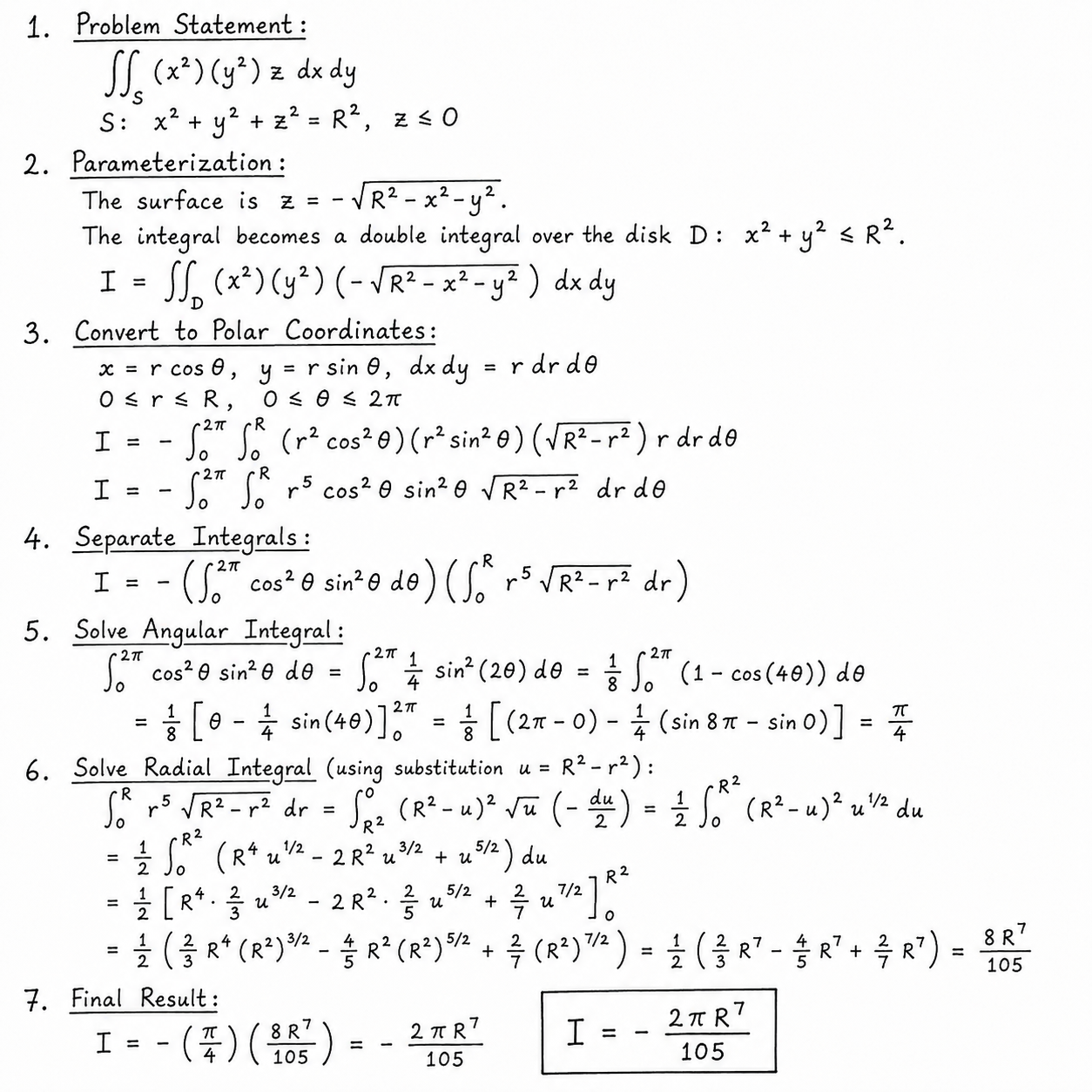













A clear, neat handwritten solution to a calculus problem on a sheet of white paper. The writing should be legible and well-organized, resembling a student's careful notes. The problem is to evaluate the surface integral ∬_S (x^2)(y^2)z dx dy, where S is the lower hemisphere x^2 + y^2 + z^2 = R^2, z ≤ 0. The solution should show the following steps clearly: 1. **Problem Statement:** ∬_S (x^2)(y^2)z dx dy S: x^2 + y^2 + z^2 = R^2, z ≤ 0 2. **Parameterization:** The surface is z = -√(R^2 - x^2 - y^2). The integral becomes a double integral over the disk D: x^2 + y^2 ≤ R^2. I = ∬_D (x^2)(y^2)(-√(R^2 - x^2 - y^2)) dx dy 3. **Convert to Polar Coordinates:** x = r cos(θ), y = r sin(θ), dx dy = r dr dθ 0 ≤ r ≤ R, 0 ≤ θ ≤ 2π I = - ∫[from 0 to 2π] ∫[from 0 to R] (r^2 cos^2(θ))(r^2 sin^2(θ))(√(R^2 - r^2)) r dr dθ I = - ∫[from 0 to 2π] ∫[from 0 to R] r^5 cos^2(θ)sin^2(θ)√(R^2 - r^2) dr dθ 4. **Separate Integrals:** I = - (∫[from 0 to 2π] cos^2(θ)sin^2(θ) dθ) * (∫[from 0 to R] r^5√(R^2 - r^2) dr) 5. **Solve Angular Integral:** ∫[from 0 to 2π] (1/4)sin^2(2θ) dθ = (1/8)∫[from 0 to 2π] (1 - cos(4θ)) dθ = (1/8)[θ - (1/4)sin(4θ)]|[from 0 to 2π] = π/4 6. **Solve Radial Integral (using substitution u = R^2 - r^2):** ∫[from 0 to R] r^5√(R^2 - r^2) dr = ∫[from R^2 to 0] (R^2 - u)^2 √u (-du/2) = (1/2)∫[from 0 to R^2] (R^4 u^(1/2) - 2R^2 u^(3/2) + u^(5/2)) du = 8R^7/105 7. **Final Result:** I = - (π/4) * (8R^7/105) The final answer, clearly boxed at the bottom: **I = -2πR^7/105**
Free to start · Generate videos and images with AI in seconds