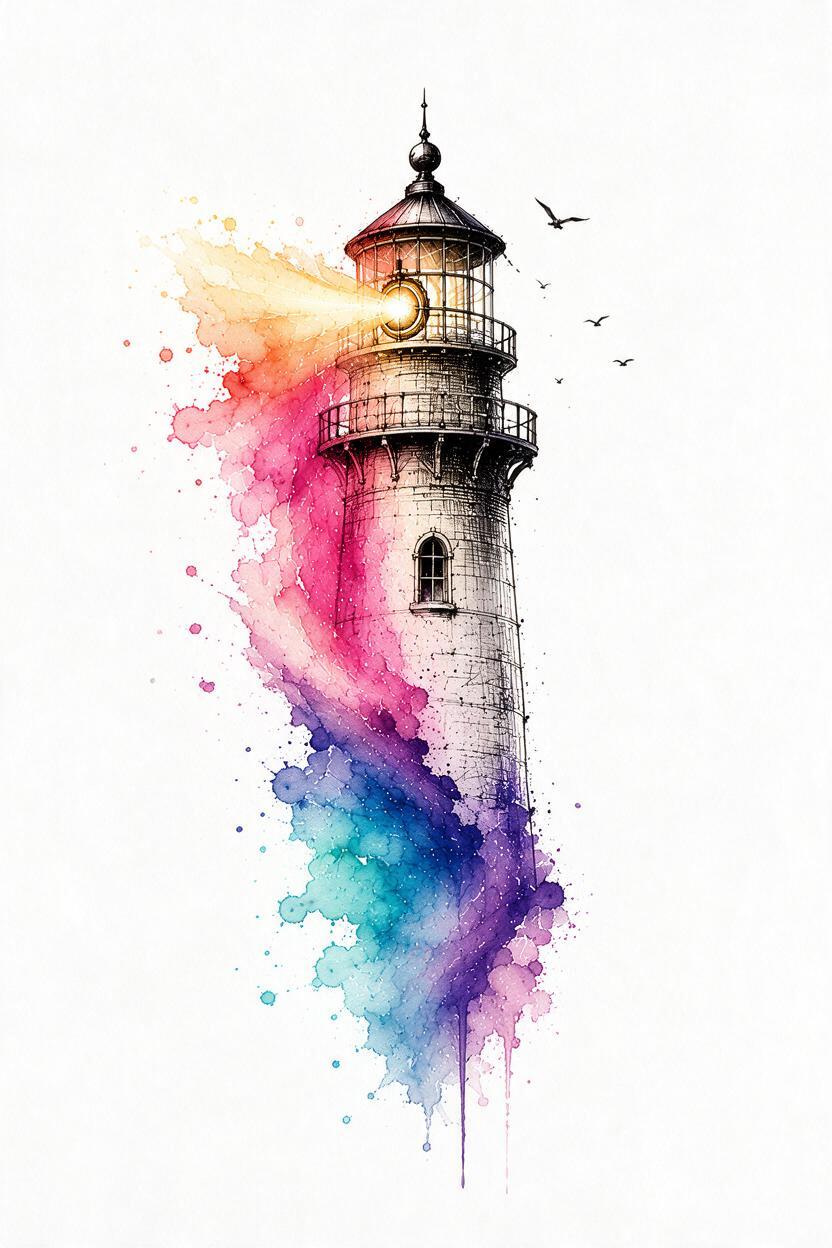













Use the uploaded image as the primary composition reference. Preserve the lighthouse proportions, elegant architectural details, ink linework, watercolor palette, and overall vertical composition. Do not redesign the lighthouse or change the concept. Move the lantern room slightly to the left so it becomes the true origin of the composition. The warm light should softly emerge from the lantern and naturally dissolve into watercolor rather than forming a defined beam. Reduce the amount of watercolor by approximately 15–20%. Keep the watercolor close to the lighthouse, making the composition lighter, more elegant and airy. Preserve the lower watercolor flow almost exactly as in the reference. The lighthouse should not be symmetrical. The right side should remain fully intact — crisp black ink architecture, delicate linework, detailed crosshatching and perfectly readable structure. The left side should gradually cease to exist. Instead of ending abruptly, it should slowly dissolve into translucent watercolor pigments, as if water is gently washing away black ink on watercolor paper. The transition must be seamless, feathered and almost invisible. There should never be a clear border between lighthouse and watercolor. The watercolor should not look like paint placed behind the lighthouse. It should feel as though the lighthouse itself is transforming into light, wind and color. The pigments should naturally flow outward from the dissolving architecture, preserving the impression that the structure is slowly becoming pure watercolor. Use soft watercolor blooms, subtle pigment diffusion and only a few delicate splatters. Avoid large paint explosions or heavy color clouds. Leave plenty of untouched white space so the composition feels breathable and refined. Preserve the vibrant palette of warm yellow, coral, magenta, violet, turquoise and deep blue. Maintain a clean white background and a sophisticated fine art watercolor tattoo aesthetic. The final artwork should feel poetic rather than decorative—as if the lighthouse is slowly becoming light itself. The lighthouse must remain recognizable and complete at first glance. The dissolving effect should only become noticeable upon closer inspection.
Free to start · Generate videos and images with AI in seconds