Image - 2026-07-28 15:05
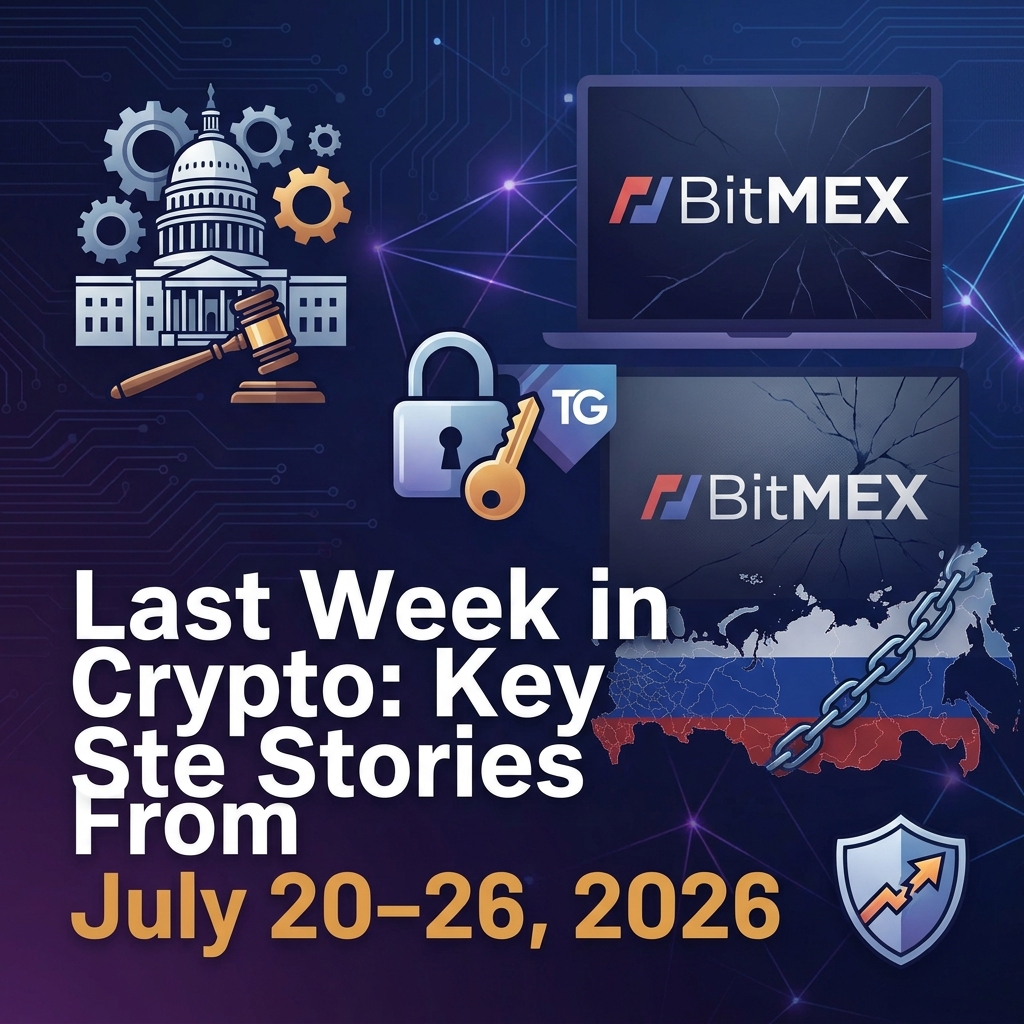
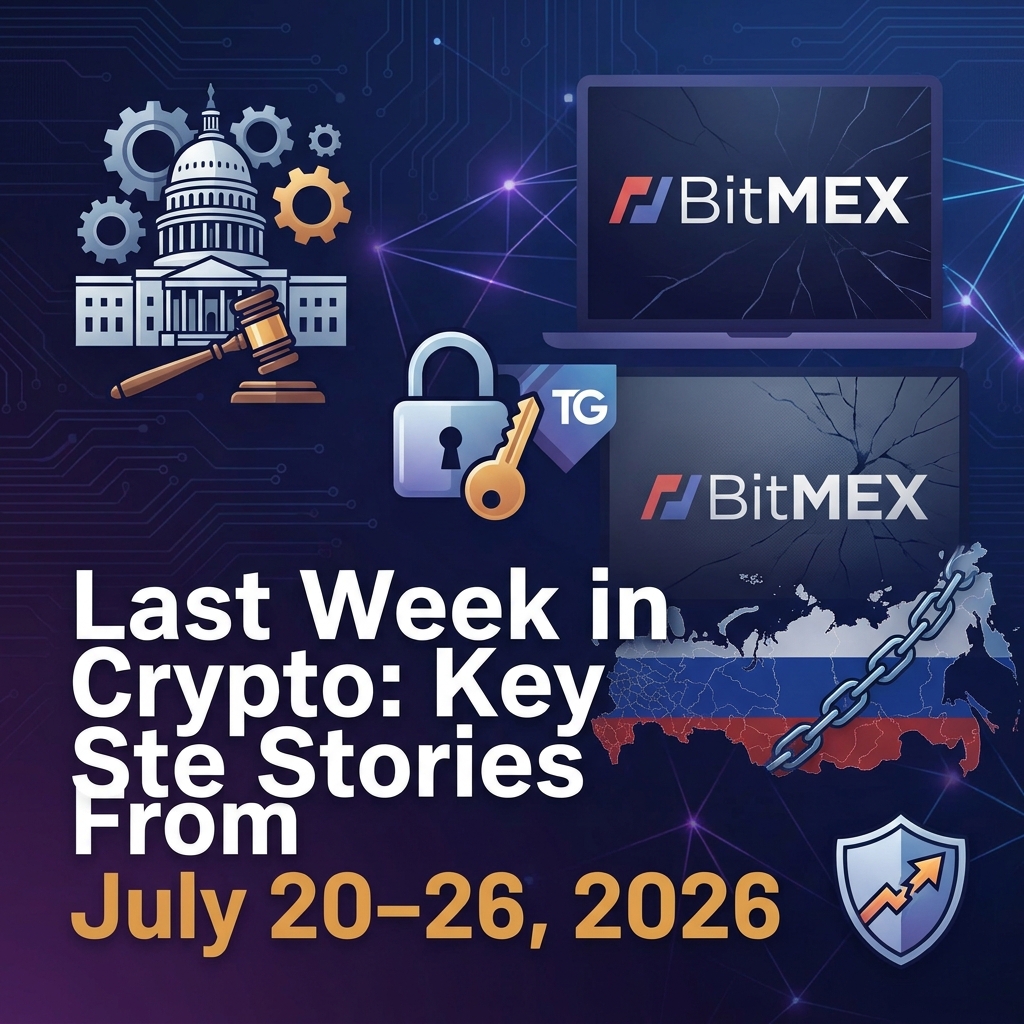
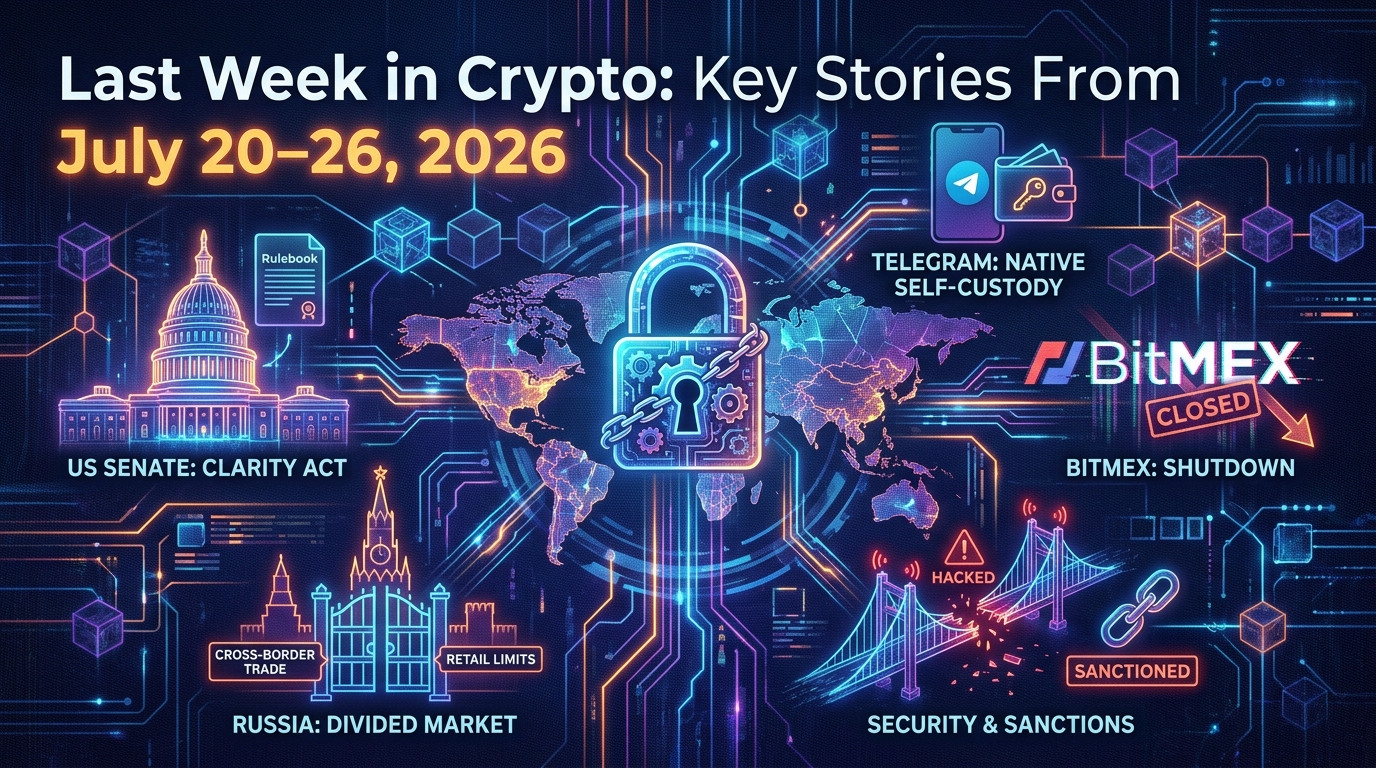
give me a blog article cover with the text: "Last Week in Crypto: Key Stories From July 20–26, 2026" write the date in a different color. For the visual, use the article itself and come up with something unique that relays the vibe of the article: Last Week in Crypto: Key Stories From July 20–26, 2026 U.S. senators revised the rules for digital assets, Russia opened a tightly controlled investment market, Telegram promised a native self-custody wallet, and BitMEX prepared to close. Last week's largest crypto stories shared a common subject: control. U.S. lawmakers tried to define which regulators should supervise tokens, exchanges and DeFi platforms. Russia decided who may buy crypto, how much they may purchase and which intermediaries can serve them. Telegram promised to put private-key control inside every version of its messenger. BitMEX, meanwhile, announced that it would close after losing its place in the derivatives market it once helped shape. A new round of sanctions and several protocol attacks offered a less theoretical view of control - who can restrict access, who holds administrative keys and how much damage follows when those keys fail. The Senate Tried to Turn Crypto Ambiguity Into a Rulebook On July 22, U.S. Senate Republicans released the latest text of the Clarity Act, a broad market-structure bill designed to divide responsibility for digital assets between federal regulators. The proposal is not law. It still needs at least eight Democratic votes to advance in the Senate, and several of its most contested provisions remain open to negotiation. Even so, the text shows where the American debate has moved after years of lawsuits, enforcement actions and disputes over whether individual tokens should be treated as securities or commodities. One of the sharpest disagreements concerns rewards paid on stablecoin balances. The bill would prohibit rewards on idle holdings when they resemble interest on a bank deposit. Rewards connected to actual activity - such as making a payment with a stablecoin - could remain permissible. The SEC, CFTC and Treasury Department would be responsible for writing the detailed rules. Banks argue that yield-bearing stablecoin accounts could pull deposits away from regulated lenders. Crypto companies see the proposed restriction as protection from competition. The argument is not only about rewards. It is about whether stablecoins will remain payment instruments or begin competing directly with bank accounts as a place to hold liquid money. The DeFi provisions approach control from another direction. A platform would struggle to qualify as sufficiently decentralized if its operators can block users, rely on private permissions or retain special privileges unavailable to everyone else. Such a system could be treated more like a financial institution, bringing it under anti-money-laundering, customer-identification and transaction-monitoring requirements. That test may prove more useful than simply asking whether a project calls itself decentralized. Many protocols run through public smart contracts while still depending on upgrade keys, privileged signers or a small group capable of changing the system. Under the proposed framework, those powers could carry regulatory consequences. The bill is equally direct about tokenized securities. Putting an equity or bond on a blockchain would not remove the legal obligations attached to the underlying instrument. A tokenized stock would remain a stock for regulatory purposes, even if its settlement infrastructure changed. The difficult part begins now. The proposal tries to address stablecoin rewards, DeFi, token fundraising, financial crime and political conflicts of interest in one piece of legislation. Passing a broad framework will require lawmakers to agree not only on what crypto is, but also on which forms of control should turn software developers and platforms into regulated intermediaries. Russia Opened the Market, but Kept Payments Closed Russia moved in a different direction. On July 21, the State Duma passed cryptocurrency legislation in its second and third readings. The Bank of Russia said the main rules are due to take effect on September 1, 2026, followed by a transition period for licensing market participants through July 1, 2027. The system gives retail investors access to crypto, but not without limits. Non-qualified investors will need to pass a test and use regulated intermediaries. They will be allowed to buy the most liquid cryptocurrencies, with purchases capped at ₽300,000 per year through each intermediary. Qualified investors must also complete testing, but they will be able to trade a wider range of assets without the same monetary limit. The infrastructure will include crypto exchanges, digital repositories, brokers, asset managers and organized trading venues. Foreign stablecoins will fall under the framework as well. This is not a general legalization of cryptocurrency payments. Using crypto to pay for goods and services inside Russia will remain prohibited. Exporters and importers, however, will be allowed to use digital assets in cross-border settlements without quantitative limits, either through intermediaries or directly with different wallets and cryptocurrencies. That creates two separate markets. Domestic users receive controlled access to crypto as an investment asset. International trade receives a broader channel for settlement, reflecting Russia's search for payment routes that do not depend entirely on Western banking infrastructure. The contrast with the U.S. proposal is revealing. American lawmakers are trying to classify assets and determine when a platform becomes a regulated intermediary. Russia is building the market around licensed intermediaries from the outset, adding investor tests, purchase limits and reporting obligations. Both approaches bring crypto further inside the financial system. They simply disagree on how much access should exist before supervision begins. BitMEX Is Closing After the Market Moved On BitMEX announced that its exchange will stop operating on September 23 at 04:00 UTC. New registrations have already ended. From August 26, users will only be able to reduce their positions, and BitMEX plans to force-close any positions that remain as the shutdown approaches. Customers who leave assets on the platform after closure may be charged an account fee. The company said its board made the decision after reviewing the business and the wider crypto industry. It did not identify one specific cause. The immediate market impact is likely to be small. Data cited by Reuters placed BitMEX's daily trading volume at roughly $400,000 and its market share below 0.01% by the time of the announcement. Its historical role was much larger. BitMEX helped make perpetual swaps and high-leverage crypto derivatives central to digital-asset trading. The exchange became closely associated with a market that operated around the clock and offered exposure without requiring traders to hold the underlying asset. Those products did not disappear as BitMEX declined. They spread. Large centralized exchanges built deeper markets and broader retail distribution. Decentralized platforms brought perpetual trading onchain. Competitors copied the basic product while adding local licenses, more assets, different interfaces and larger pools of liquidity. BitMEX's closure is therefore not the end of the market it helped develop. It is evidence that originating a popular product does not guarantee permanent control over it. The exchange still describes itself as secure and says no customer funds were lost to hacks during its operating history. That claim comes from BitMEX rather than an independent audit, but it makes the outcome more striking: the platform is not closing after a public insolvency or catastrophic theft. It is closing after its relevance and liquidity moved elsewhere. Telegram Wants Self-Custody to Feel Like Messaging Pavel Durov used a short Telegram post to announce a much larger ambition. He said Telegram would bring a native, non-custodial Gram wallet to every Telegram app during the summer of 2026. The post promised instant crypto transfers without user fees and described the project as the largest rollout of a self-custody wallet in history. The distribution opportunity is obvious. Most non-custodial wallets have to persuade users to download a separate application, create an address, protect recovery credentials and obtain funds for network fees. Telegram can place the entry point inside a service people already use for conversations, bots, Mini Apps and digital goods. The announcement provided almost none of the details needed to judge the product. Telegram has not published an exact release date, a list of supported networks or a full explanation of key recovery. Durov did not say whether free transactions will be subsidized, processed through a separate payment layer or limited to certain transfers. Nor did he explain how the new wallet will coexist with the custodial Crypto Wallet and the existing non-custodial DeFi Account already available in Telegram's wider ecosystem. A billion Telegram users should not be confused with a billion wallet users. The meaningful numbers will come later: activated wallets, funded addresses, repeat transactions and uses that survive after the novelty of the launch fades. Telegram has largely solved the distribution problem. The harder question is whether it can make self-custody understandable to users who did not join a messaging app to manage private keys. Sanctions and Security Narrowed the Edges The week also showed how crypto access can be restricted without changing the underlying blockchain. The European Union included HTX, formerly known as Huobi, in its latest sanctions package against Russia. The exchange appeared among 18 crypto-service companies that the EU said had helped Russian users evade sanctions. The measure is narrower than a full blocking designation. It does not automatically freeze all HTX assets or order the exchange to close. It does place a major international platform inside a sanctions framework that had often focused on smaller exchanges, payment networks and individual addresses. HTX had already been sanctioned by the United Kingdom in May. Following that decision, the exchange said regulatory compliance remained a priority, but it did not provide Reuters with an immediate response to the EU action. The change is significant for global exchanges. Blocking a few known wallet addresses or restricting access from selected IP ranges may no longer satisfy regulators. Authorities are looking at actual transaction routes, customer relationships and the role platforms play in moving funds outside conventional financial channels. Attackers tested a different kind of boundary on July 23. AFX, the Verus–Ethereum bridge and B² Network lost more than $35 million across three incidents within roughly six hours, according to CoinDesk's analysis of blockchain data and reports from security firms. AFX lost about $24.15 million from a bridge on Arbitrum. The Verus–Ethereum bridge lost approximately $7.54 million, while B² Network lost around $3.86 million after an attacker obtained control of the upgrade authority for its staking contract. None of the incidents required breaking the cryptography of Bitcoin, Ethereum or Arbitrum. The weaknesses sat in bridge logic, administrative permissions and privileged keys. In the B² case, gaining access to the upgrade authority gave the attacker the power to alter how the staking contract behaved. The code did not need an unknown mathematical flaw once the attacker controlled the permission to change it. The Verus incident was harder to explain as an unforeseeable failure. The same bridge had been attacked through the same class of weakness earlier in the year. Most of the funds from that incident were returned after a bounty agreement, and recovered assets were later deposited back into the bridge. It was drained again two weeks after the redeposit. That is not simply a smart-contract problem. It is a remediation problem: funds returned before the weakness that exposed them had been fully removed. A separate incident occurred on July 25 and was publicly confirmed two days later. Payment company Triple-A said unauthorized access affected wallets holding its own digital assets. Some services were placed into maintenance mode for about three hours, but the company said client funds were not exposed because they were held separately in trust accounts with safeguarding institutions. Triple-A did not disclose the size of the loss in its statement. The separation did not prevent access to the company's treasury wallets. It did prevent the same incident from automatically reaching customer money. That principle applies beyond regulated payment providers. A guide to digital payment hygiene for small businesses makes a related point: customer receipts, operating funds and reserves should not automatically share the same wallet, transaction history and risk profile. The aim is not to build an unmanageable maze of addresses. It is to stop one compromised key, exposed account or mistaken approval from revealing or endangering every part of the treasury. What the Week Changed No single event settled crypto's largest questions. The Clarity Act still needs bipartisan support. Russia's new framework still requires licensed intermediaries and implementation rules. Telegram has not explained how its free, non-custodial wallet will work in practice. BitMEX still has two months to unwind positions and return remaining assets. The direction is clearer than the outcome. Crypto markets are being shaped less by whether a blockchain can process a transaction and more by the controls around that transaction: legal classifications, access limits, sanctions, recovery systems, administrative permissions and the separation of funds. The technology may be open. The systems built around it rarely are.
Free to start · Generate videos and images with AI in seconds
More from this creator




More L images
См. все →