Image - 2026-08-15 19:27
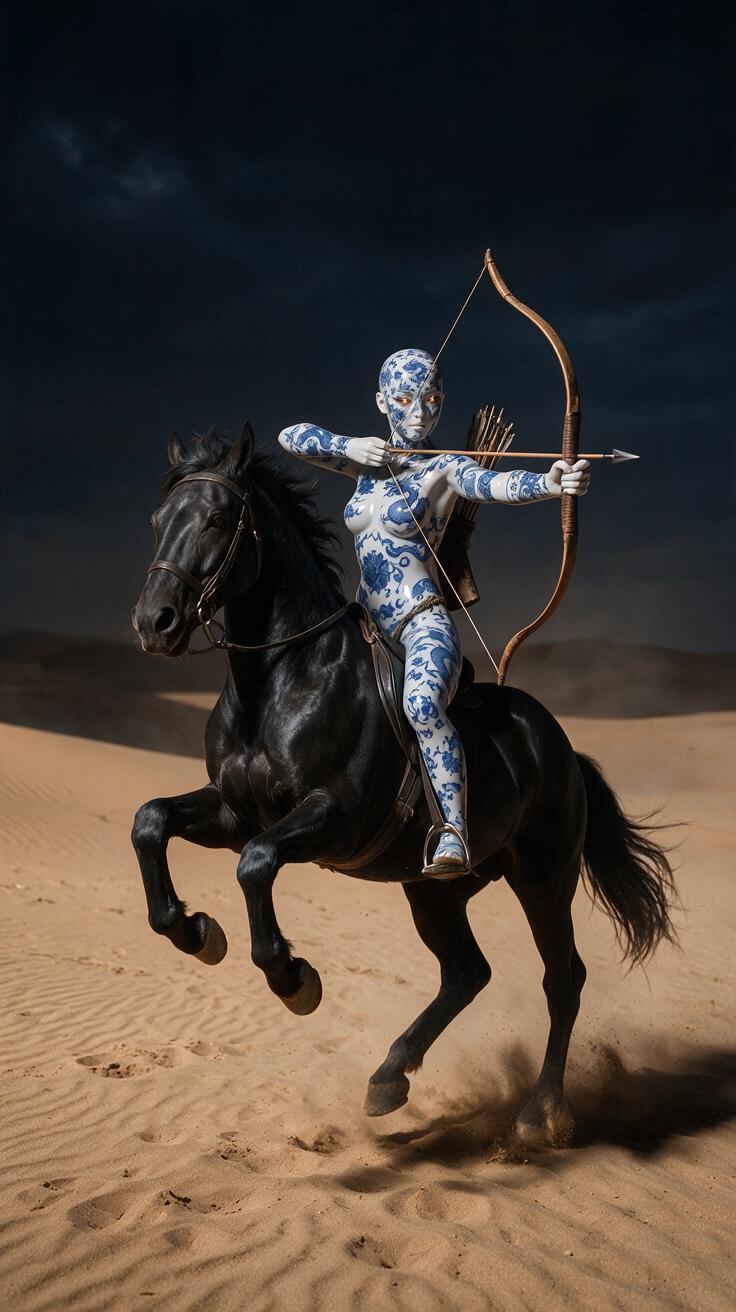
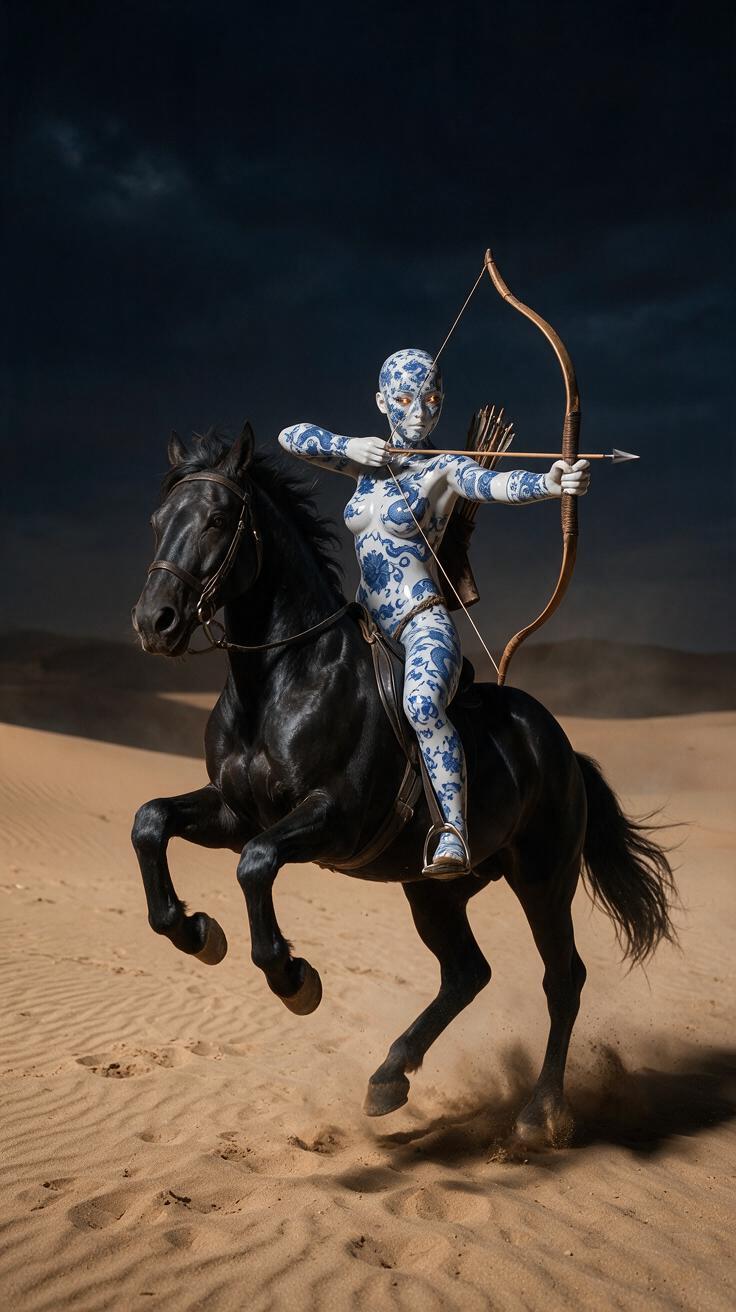
Der Begriff ist quiver – auf Deutsch Köcher. Ich habe den Prompt komplett neu aufgebaut und besonders auf echtes Porzellan, anatomisch korrekte Bogenschützenhaltung, das steigende Pferd und natürliches Licht geachtet. Use the attached reference image as the strict visual reference for the porcelain woman. Preserve her facial features, hairstyle, clothing design, proportions, colors, ornamental details, and overall visual identity as closely as possible to the reference. Create an extremely realistic, professional cinematic wide-angle photograph of this porcelain woman riding a magnificent real black horse in a vast desert. The woman herself is an unmistakable lifelike sculpture made entirely from genuine, high-quality glazed porcelain. She must NOT look like a human woman with pale or glossy skin. Her face, neck, hands, body, clothing, and visible details should have the authentic material characteristics of fine handcrafted porcelain: a smooth fired ceramic surface, rich glossy glaze, subtle natural reflections, delicate highlights, extremely fine surface details, slight handcrafted irregularities, realistic ceramic depth, and the unmistakable hard, polished appearance of premium porcelain. Her porcelain surface should have the same convincing material quality one would see on an exquisite antique porcelain vase or luxury porcelain figurine. The glaze catches the natural light beautifully, creating intense but physically realistic reflections and highlights that immediately make it obvious that the woman is made from real glazed porcelain. She is riding a powerful, anatomically accurate black horse. The horse is real, living, muscular, highly detailed, and naturally proportioned, with realistic black hair, individual strands in the mane and tail, authentic skin and muscle definition, realistic eyes, nostrils, tack, reins, saddle, and leather materials. At the exact moment of the photograph, the black horse is rearing dramatically onto its hind legs, with both front legs raised naturally off the ground. Its body weight, musculature, leg positioning, balance, mane movement, and interaction with the sand must be physically believable. Sand is naturally disturbed beneath the horse’s hind hooves. The porcelain woman remains perfectly balanced in the saddle with a physically believable equestrian posture. A quiver filled with arrows is securely attached to her back. The quiver, arrows, straps, and attachment system must be historically and physically plausible. The arrows sit naturally inside the quiver with their feather fletching clearly visible. Nothing floats, intersects, or clips through her body, hair, clothing, bow, saddle, or horse. Unlike the previous pose, she is now holding her bow in both hands, fully drawn and under tension. She is actively aiming the drawn bow directly toward the camera lens, creating an intense, powerful perspective. Her archery technique must be convincing and physically accurate: correct grip, correct draw hand, realistic finger placement, proper bowstring tension, correct alignment of the arrow with the bow and string, believable shoulder and elbow positioning, and a natural anchor point. The arrow is properly nocked onto the bowstring and aligned toward the camera. The bow visibly bends under realistic tension. Her hands, fingers, arms, bow, bowstring, and arrow must be anatomically and mechanically correct. The scene takes place in a vast, completely realistic desert with authentic natural sand, fine grains, subtle dunes, wind-shaped textures, realistic hoof impressions, and atmospheric depth. The desert should feel enormous, isolated, ancient, and real rather than like a fantasy illustration or artificial movie set. The overall atmosphere is dark, mysterious, mystical, and cinematic, but everything remains photorealistic. Most of the surrounding desert disappears gradually into deep natural darkness, atmospheric haze, distant shadow, and subtle desert dust. The edges and distant background are significantly darker, creating an almost mysterious void around the central subject. However, natural directional light falls precisely onto the area occupied by the woman and the black horse, as though a break in heavy clouds or a narrow opening in the sky allows real sunlight to reach this specific part of the desert. This must NOT look like artificial spotlighting, stage lighting, fantasy illumination, glowing magic, CGI light, or animated effects. The illumination must remain completely natural and physically plausible, with realistic falloff, realistic shadows, natural reflections, believable atmospheric scattering, and authentic interaction between sunlight, porcelain, horse, and sand. The natural light strikes the glazed porcelain particularly beautifully, producing strong, crisp, realistic specular reflections across the porcelain surface. These highlights emphasize the smooth ceramic glaze and make the material immediately recognizable as genuine porcelain. The black horse absorbs much of the light while subtle highlights reveal its muscular anatomy, creating a dramatic visual contrast between the deep black living horse, luminous glazed porcelain woman, warm natural desert sand, and surrounding darkness. Capture the entire scene as a professional high-end cinematic wide-angle photograph, approximately 24mm full-frame lens, with the camera positioned at a dramatic but believable distance and slightly lower perspective. The complete horse and rider must remain visible within the composition, including the raised front legs and the contact of the hind hooves with the desert floor. Leave enough surrounding desert visible to communicate the enormous scale and isolation of the landscape. The wide-angle perspective should feel immersive and powerful without becoming a fisheye image. Preserve natural anatomy and proportions without excessive lens distortion. Visual quality: ultra-photorealistic, professional full-frame photography, cinematic 24mm wide-angle composition, realistic optical characteristics, extremely detailed glazed porcelain, authentic ceramic reflections, physically accurate horse anatomy, realistic black horse hair and musculature, authentic archery equipment, realistic bow tension, realistic leather tack, individual sand grains, natural desert dust, atmospheric depth, natural directional sunlight, realistic shadows, physically based reflections, subtle volumetric atmosphere, dramatic natural contrast, premium fine-art photography, extremely high material realism. Critical requirements: The woman must unmistakably look like a genuine glazed porcelain sculpture, NOT a human with porcelain-colored skin. The horse must look completely real and anatomically correct. The horse is rearing naturally on its hind legs. The quiver remains securely attached to the woman’s back and contains realistic arrows. She holds a drawn bow and aims the arrow toward the camera lens. Bow, arrow, string, hands, fingers, arms, quiver, straps, saddle, reins, horse, and rider must all interact physically correctly. No fantasy glow. No magical particles. No artificial spotlight. No CGI appearance. No cartoon style. No illustration. No plastic skin. No metallic porcelain. No fisheye distortion. No malformed horse anatomy. No extra legs. No deformed hands. No extra fingers. No floating equipment. No duplicated arrows. No impossible bowstring. No objects clipping through the body, clothing, horse, or equipment. The final result should look like an extraordinary real photograph captured in an actual desert: a genuine porcelain woman riding a real rearing black horse, aiming her drawn bow directly toward the camera, surrounded by mysterious natural darkness and illuminated by a dramatic but entirely believable source of natural light.
Free to start · Generate videos and images with AI in seconds
More from this creator

More Seedream 5.0 images
См. все →