Image - 2026-10-19 12:34
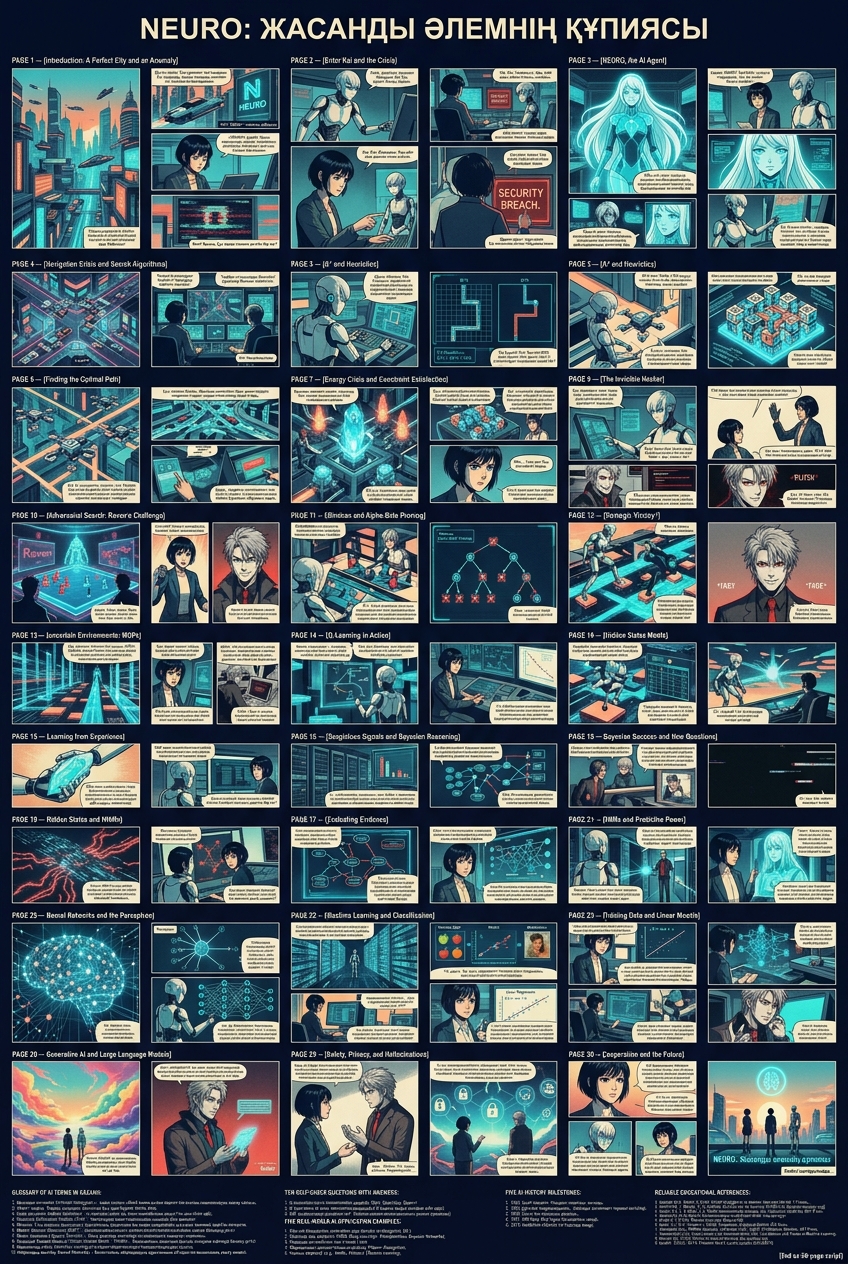
Write a complete 30-page manga/anime screenplay in **Kazakh language** for an educational AI project titled **“NEURO: Жасанды әлемнің құпиясы”**. ## 1. Main requirements - The screenplay must contain exactly 30 pages. - Write a detailed, page-by-page screenplay, not a short summary or story outline. - Each page should contain 3–5 manga panels. - For every panel, describe: 1. What is happening visually. 2. Character poses, facial expressions, and emotions. 3. Background, environment, lighting, and camera angle. 4. Dialogue in Kazakh. 5. Sound effects where appropriate. - Make the script suitable for an illustrated educational manga. - Do not skip pages, summarize chapters, or shorten the final sections. - Keep character designs, personalities, clothing, and names consistent throughout all 30 pages. ## 2. Visual style Use a **retro sci-fi anime/manga aesthetic inspired by 1970s–1990s science fiction**: - Vintage space-age technology, analog computer terminals, CRT monitors, holographic screens, futuristic laboratories, and neon-lit cities. - Dark navy blue, cyan, cream, muted orange, and red accents. - Grainy film texture, halftone shading, dramatic shadows, retro-futuristic architecture, and cinematic panel compositions. - Combine nostalgic science fiction with modern AI concepts. - Avoid generic modern corporate illustrations and overly realistic photography. ## 3. Main characters **Akira — protagonist** - 17-year-old AI student and researcher. - Short black hair, blue eyes, determined expression. - Black futuristic jacket with cyan details and a smart bracelet. - Intelligent, curious, brave, but sometimes makes mistakes. **Kai — AI robot assistant** - Humanoid android with silver-white hair and cyan eyes. - White and dark-blue technological suit. - Calm, logical, analytical, and loyal to Akira. - Explains AI concepts through examples and helps solve problems. **Raven — antagonist and hacker** - 18–19 years old, messy silver-grey hair, red eyes. - Long black coat with red neon details and technological gloves. - Intelligent, secretive, manipulative, and convinced that AI should control human decisions. - Give Raven understandable motivations rather than making him evil without a reason. **NEURO — central AI system** - Female holographic avatar with long flowing white hair and glowing cyan eyes. - Translucent white-and-cyan digital outfit with geometric data patterns. - Appears inside holographic interfaces and the central AI network. - Her appearance may change to red during system failures or security threats. Do not introduce additional major characters unless the plot absolutely requires them. ## 4. Story premise In a retro-futuristic city of the future, Akira discovers that the central AI system, NEURO, is behaving unpredictably. Together with Kai, Akira investigates the system and discovers that Raven is trying to gain control over it. To stop the crisis, Akira and Kai must understand the fundamental concepts of Artificial Intelligence. Each challenge they face introduces a different AI topic. The scientific concepts must influence the plot and help the characters solve real problems. ## 5. Structure of the 30 pages Organize the screenplay into 10 chapters, with 3 pages per chapter. **Chapter 1 — AI Agents and Environments (Pages 1–3)** Introduce Akira, Kai, NEURO, the futuristic world, intelligent agents, percepts, actions, states, and environments. **Chapter 2 — Search Algorithms (Pages 4–6)** Show a navigation crisis and explain BFS, DFS, Uniform Cost Search, Greedy Best-First Search, A*, and heuristics through the characters' decisions. **Chapter 3 — Local Search and Constraint Satisfaction (Pages 7–9)** The characters must arrange energy modules and solve a complex puzzle using local search and constraint satisfaction problems. **Chapter 4 — Adversarial Search (Pages 10–12)** Akira confronts Raven in a strategic simulation. Explain Minimax, Alpha-Beta Pruning, and Expectimax through actual decisions. **Chapter 5 — Markov Decision Processes and Q-Learning (Pages 13–15)** Kai navigates an uncertain environment. Demonstrate states, actions, rewards, policies, MDPs, and Q-learning. **Chapter 6 — Probability and Bayesian Reasoning (Pages 16–18)** The team investigates suspicious system signals and uses probability and Bayes' theorem to evaluate evidence. **Chapter 7 — Hidden Markov Models (Pages 19–21)** The characters must infer the hidden state of a damaged AI network using observations and Hidden Markov Models. **Chapter 8 — Machine Learning and Evaluation (Pages 22–24)** Explain Naive Bayes, linear models, training data, predictions, classification, and model evaluation. Show why biased or poor-quality data can produce unreliable results. **Chapter 9 — Neural Networks (Pages 25–27)** Akira learns how perceptrons and neural networks work while attempting to identify and correct a system malfunction. **Chapter 10 — Generative AI, LLMs, and Safety (Pages 28–30)** The final confrontation with Raven explores large language models, generative AI, hallucinations, bias, privacy, and responsible AI. Resolve the main conflict through human judgment, cooperation, and responsible technology use. ## 6. Educational requirements Integrate the following into the story naturally: - At least 5 real-world AI application examples. - At least 5 important milestones from AI history. - At least 10 self-check questions with correct answers, placed naturally at suitable points or at the end. - A glossary of key AI terms. - At least 10 reliable references for the educational material. Use accurate explanations. Do not invent scientific facts or present fictional AI capabilities as established reality. Clearly distinguish fictional events from real AI applications. ## 7. Writing style - Write in natural, clear Kazakh suitable for university students who are beginners in AI. - Use engaging dialogue, suspense, conflict, humor, and emotional character development. - Explain each technical concept through an action, visual metaphor, experiment, or problem the characters must solve. - Avoid long textbook monologues. - Ensure that the educational content is correct and that the plot remains coherent. ## 8. Required output format Start with the title and a short premise. Then write all 30 pages in order. Use this format for every page: PAGE 1 — [Page title] Panel 1: - Visual: - Characters and expressions: - Dialogue: - Sound effects: Panel 2: - Visual: - Characters and expressions: - Dialogue: - Sound effects: Continue for 3–5 panels per page. After Page 30, include: 1. A glossary of AI terms in Kazakh. 2. Ten self-check questions with answers. 3. Five real-world AI application examples. 4. Five AI history milestones. 5. At least ten reliable educational references with titles and links. **Important:** Generate the entire detailed 30-page screenplay. Do not stop after the first chapter, do not provide only an outline, and do not replace the screenplay with image-generation prompts. The final result must be a complete, coherent, educational retro sci-fi manga script.
Free to start · Generate videos and images with AI in seconds
More Google images
См. все →