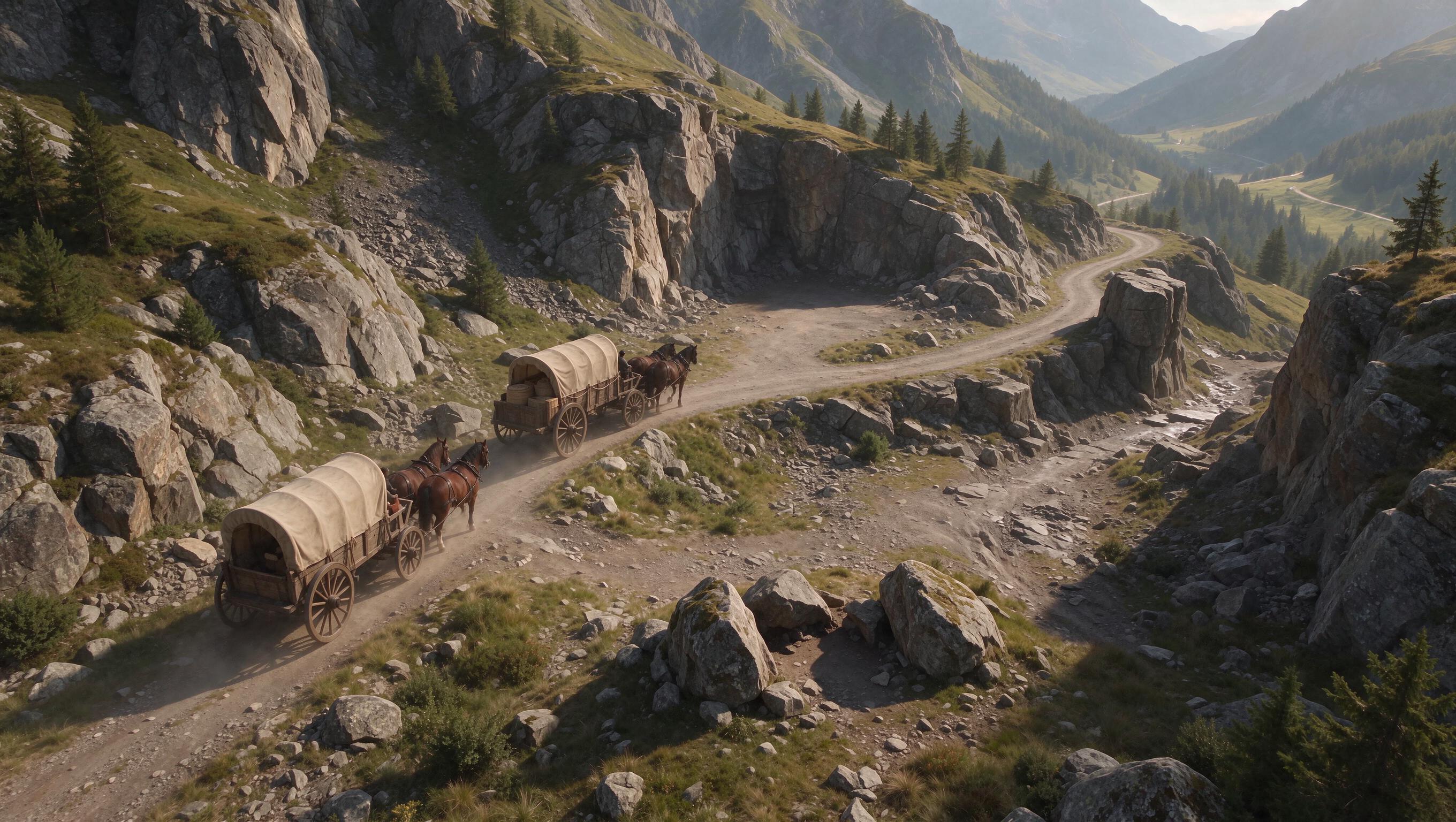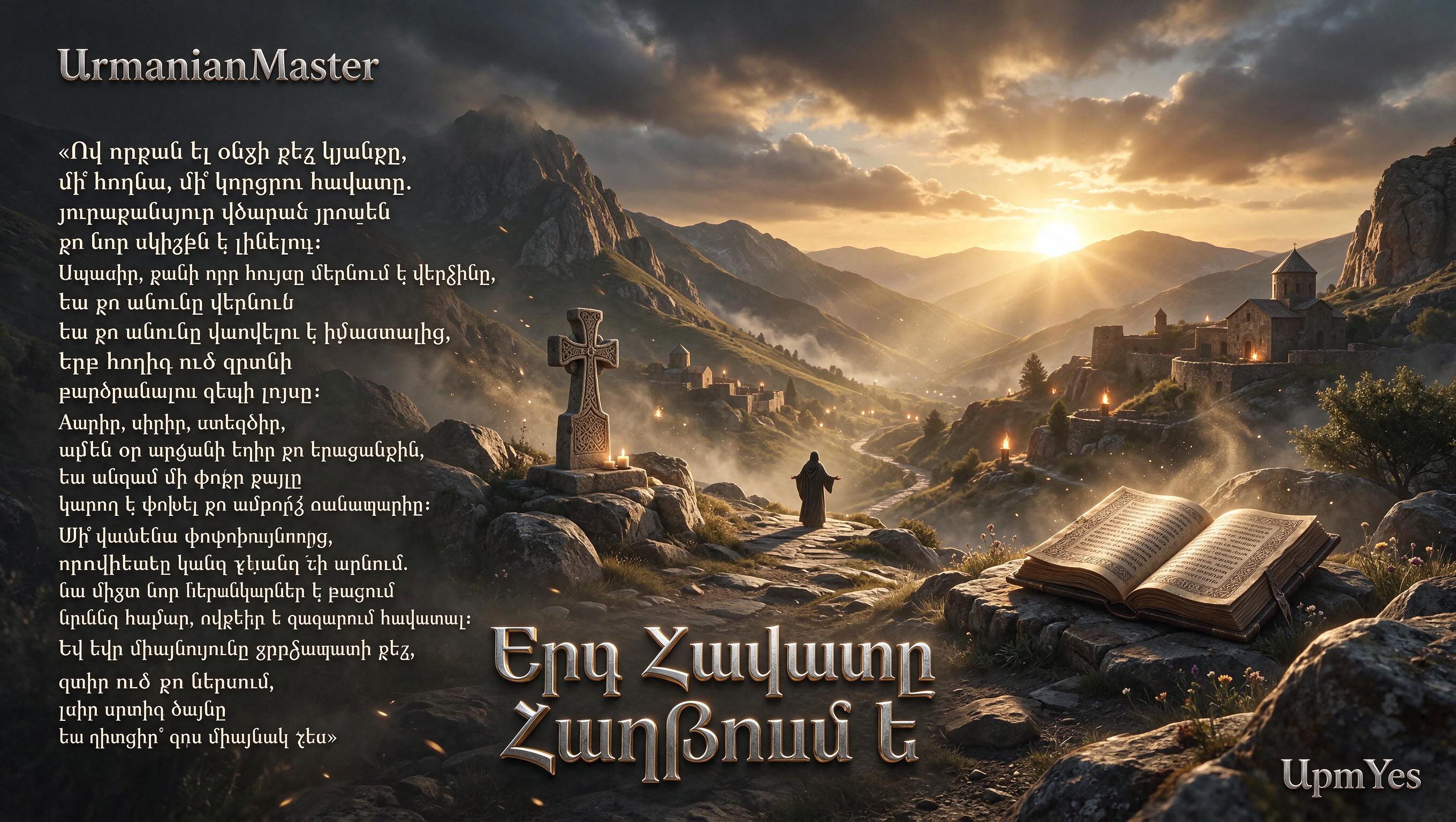
Image - 2026-11-27 19:46
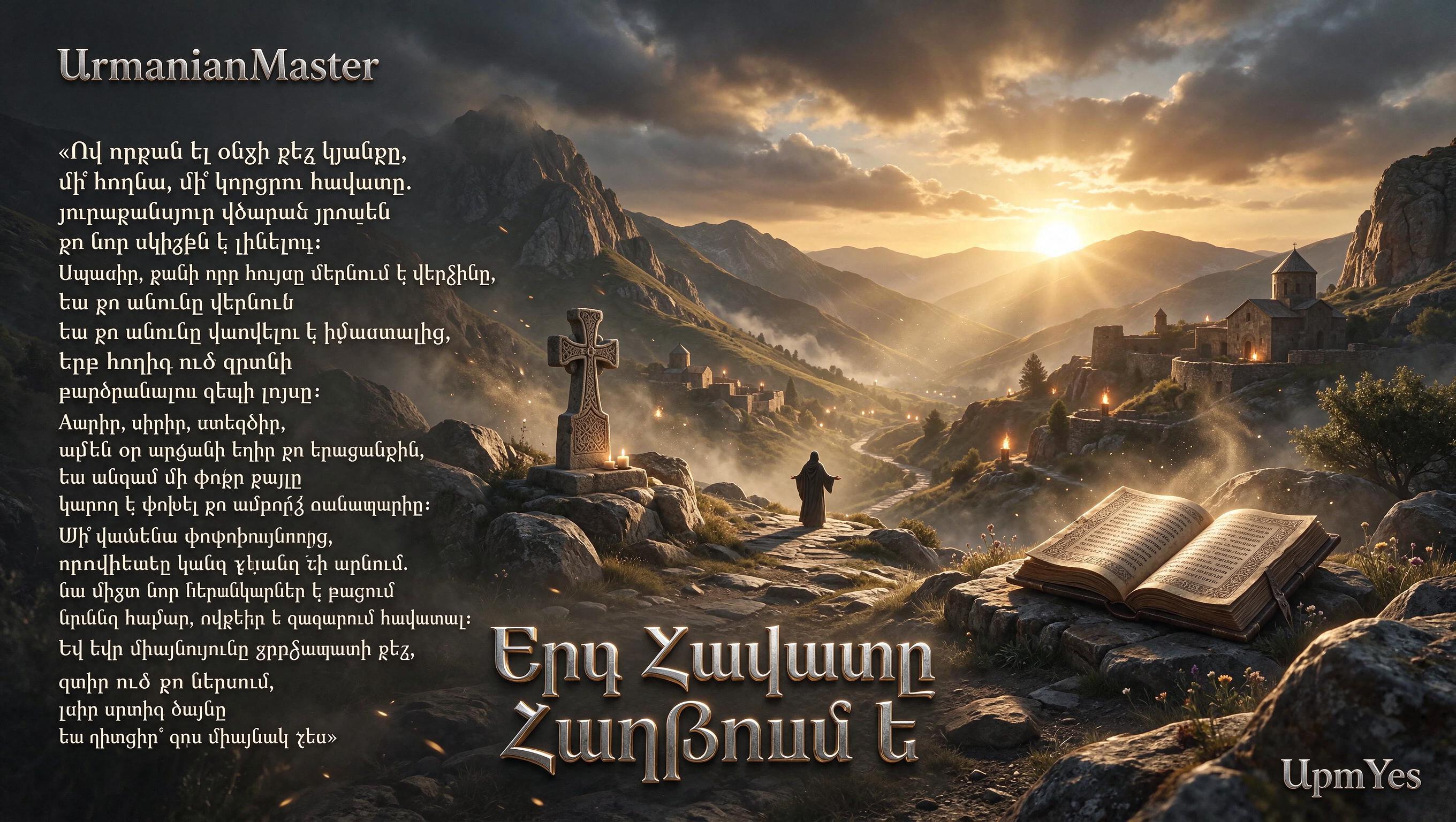
ULTRA-PREMIUM CINEMATIC POSTER — ARMENIAN MASTER | v3.9.1 FINAL BODY-FIRST • ADAPTIVE TYPE • ARMENIAN OPTICAL BENCHMARK • COMPACT TITLE STAGE 1: QHD 2560 × 1440 | STAGE 2: 4K 3840 × 2160 sRGB PNG + EDITABLE SVG | TRUE 16:9 NEW HY — MODE AND EXECUTION Create ONE original flagship Armenian cinematic poster. This master governs NEW art; for RU/EN-US localization or authorized HY BODY restoration use ARMENIAN_POSTER_LOCALIZATION_MASTER_RU_EN-US_v3.9.1_FINAL.txt. The shared standards and logo lock are identical; companion: 21V25_LOGO_SIZE_LOCK_QHD_4K_SYNC_v1.3.txt. Mode limits and hard gates override additional wishes. SOURCE FIELDS — one poster per run ↓↓↓ FIELD 1 — EXACT TITLE (REQUIRED) ↓↓↓ [INSERT EXACT ARMENIAN TITLE] ↑↑↑ END FIELD 1 ↑↑↑ ↓↓↓ FIELD 2 — COMPLETE BODY (REQUIRED) ↓↓↓ [INSERT COMPLETE ARMENIAN BODY WITHOUT REPEATING TITLE] ↑↑↑ END FIELD 2 ↑↑↑ ↓↓↓ FIELD 3 — SERIES ID (REQUIRED) ↓↓↓ [INSERT EXACT SERIES ID] ↑↑↑ END FIELD 3 ↑↑↑ ↓↓↓ FIELD 4 — ADDITIONAL WISHES (OPTIONAL) ↓↓↓ [При необходимости] ↑↑↑ END FIELD 4 ↑↑↑ NEW HY — STAGE 0: BODY FIRST, ART SECOND Execute C in order: BODY-only count → verified font/shaping → alternative type sizes/panel geometries → reserve largest practical BODY footprint → compact title envelope and logo boxes → artistic concept. Counting is an estimate, actual glyph advances/ink decide geometry. Record all proof parameters and normalized positions before generation. Redesign layout if text cannot fit at HY minimum. Priority: BODY readability/fit → compact title → scene and mandatory miniatures → subordinate logos. Reduce title footprint first, then decorative/character footprint, never sacrificing required miniature count or readable text. Full bleed; target 4–5% canvas safety margins for title/text/logos; SERIES ID upper-left, ArmenYes subordinate corner. Avoid unjustified empty glass or oversized heading. No fixed panel-area percentage. GLASS: 1–4 calm zones sized by measured fit. Cool smoky-graphite optical glass, approximately 30% perceived graphite shading of underlying scene (not fixed alpha/transparency); preserve visible scenery, optical depth, elegant bevels, restrained reflections/refraction. Keep BODY interiors free of obstructions, figures, motifs, glare and busy high-contrast detail. No opaque black rectangle, milky frost, heavy blur or colorless pane. Check actual local contrast and maximize usable interiors before locking. ART DIRECTION: analyze TITLE/BODY after layout reservation. Record cultural/mythological/geographic or culture-neutral identity, emotional register, 3–6 semantic threads, one central narrative; derive setting, costume, symbols and anatomy from meaning, not language. No automatic Ararat/monasteries/national motifs, arbitrary religious mixing or fantasy presented as historical fact. Select 1–3 primary and 2–4 relevant supporting influences where appropriate: Luxury-Esoteric, Spiritual, Mythological, Cosmic Light & Dark, Sacred Symbolism, Medical-Esoteric, Luxury Botanical Neoclassicism, realistic Athletic Human Aesthetics. Distinct focal hierarchy, spatial arrangement, environment, camera/perspective, architecture, time, light and 2–4 coordinated colors plus accent. Compare available past masters only to avoid repetition; no mirroring/recoloring/side swaps, reused cosmic rings, gardens or luminous nervous systems as shortcuts; do not claim uniqueness against unseen art. Characters optional; vary age, face, physique, hair, costume, posture, gesture, expression and setting interaction. Plausible adult anatomy/hands/joints/skin, tasteful dress, no nudity or extra limbs. Cinematic photorealistic deep 3D, HDR appearance, physically convincing materials, global illumination, volumetric light, contact shadows, microdetail and controlled depth of field; avoid cheap CGI, stock-photo look, plastic anatomy, neon clutter and bloom. MINIATURES: 2–7, normally 2–5, each a distinct BODY-derived freestanding sculpture/object/micro-scene; record meaning, count, position, scale and depth. Use at least TWO spatial depth levels, asymmetric placement, varied elevation/size/silhouette, shared perspective/light, atmospheric depth, contact shadows and plausible reflections/interactions with environment. No repeated generic symbols, redundant claims, labels, frames, medallions, rings, containers, tiles, flat pictograms, floating stickers, uniform grids or icon strips; natural circular objects permitted if meaningful, and frames only if expressly requested or inherent to subject. Protect all BODY-safe regions. If fewer than two can fit, redesign or report blocker. Verify actual miniatures, not planned count. MATERIAL: D governs title/logos. Apply explicitly supplied visual material references only to authorized elements; use references for appearance, not copying composition. Inspect actual references and distinguish visual interpretation from verified physical assets. Retain exact title spelling and generated sculptural character; no flat SVG substitute for artistic TITLE. NEW HY — STAGE 1 After Stage 0 PASS, use an isolated self-contained generation brief: current concept, scene, character/miniatures, materials, exact empty-panel coordinates, safe regions, compact title envelope and logo caps in QHD pixels AND normalized canvas percentages, and only exact TITLE, SERIES ID and ArmenYes as visible lettering. No BODY, translations, old wording, previous poster templates or workflow instructions. Material-only reference images and expressly authorized concept references may inform appearance; never use an old poster as a NEW layout template. If context cannot be isolated, disclose and reject contamination. Generate clean scene, normalize QHD, verify anatomy, originality, miniature count/depth/frameless integration, lettering/materials/caps and actual-glass proof under E. Correct locally preserving unaffected art where practical; regenerate NEW only if needed. Preserve genuine source/title-free/material assets when available; reconstructed layers are not originals. Stop at approval gate in E. SHARED STANDARDS A–E — IDENTICAL IN BOTH MASTERS A. SOURCE, MODES AND PRODUCTION GATES Preserve supplied TITLE, BODY and SERIES ID as exact UTF-8: Unicode, punctuation, case, paragraphs and whitespace (including NBSP). Decode only intended HTML references; exclude explicitly identified nonprinting formatting markup, retaining requested style where compatible with the locked face. Record extraction conventions. No correction, translation, normalization, paraphrase, omission or addition. SERIES ID: no commas; flag conflicts. Visible wording limited to TITLE, BODY, ID and case-sensitive ArmenYes, plus expressly authorized legacy captions. Medical/esoteric themes are symbolic, not verified medical advice; invent no clinical endorsement. GATES: Stage 0 measured proof → Stage 1 clean QHD → explicit plate-specific approval → Stage 2 code-only 4K BODY → final QA. Before Stage 0 PASS, only read-only inspection, normalization and private proofs. Never send BODY/fragments/dummy text/full typeset poster to the generator. Disclose unverifiable context isolation; reject contaminated output. Missing assets/tools or failed mandatory checks block certification; never fabricate evidence or PASS. QHD: 2560 × 1440 (3,686,400 px²). Final: 3840 × 2160 (8,294,400 px²), true 16:9, full bleed, sRGB PNG and editable SVG. Use deterministic Lanczos for normalization; no stretching/bars; minimal disclosed crop only for NEW artwork. Locked references with incompatible aspect ratio block work unless separately authorized. Preserve originals, record native size, crop, actual profile or assumed sRGB, and hashes. B. ARMENIAN OPTICAL BENCHMARK & TYPE SYSTEM HY is the flagship optical benchmark: optimize actual glyph clarity, open counters, stroke cores, spacing, grayscale AA, contrast and unobstructed layout before approval. Use equivalent verified shaping/rendering/color/QA for every language. Compare representative HY/RU/EN-US passages at equal grids, 100%, 200% and normal scale (1280 × 720); judge script-specific features, not nominal size or Latin x-height. HY must not be the weaker master. Flag inferior HY for separately authorized BODY restoration; never degrade localization or silently change HY. If comparable assets are missing, parity remains unverified. BODY font locks (artistic TITLE/logos excluded): • HY: NotoSerifArmenian-SemiCondensedSemiBold.ttf, Noto Serif Armenian SemiCondensed SemiBold, v2.008, weight 600, width class 4 (87.5%), SHA-256 41452be3093eb94f58be14edcb75139534127d61dd8a0cbaf60ab838f44535c4. Minimum/starting 36 px QHD / 54 px 4K; search 36–56 px QHD and beyond when beneficial. Adaptive enlargement is mandatory when it yields a larger equally comfortable fit. Applies also to authorized HY restoration. • RU: approved Variant C, NotoSans-SemiCondensedSemiBold.ttf, Noto Sans SemiCondensed SemiBold, v2.004, weight 600, width class 4 (87.5%), SHA-256 684cb238cf7e0b051001109013c88805cac918f8a832df58be27a8ef927bff77. Start 38/46 px QHD (size/leading), 57/69 px 4K. • EN-US: same verified RU face by default; start 41/50 px QHD, 61.5/75 px 4K (21V43 reference). RU/EN-US 36–44 px QHD is an initial search range, not a ceiling or target. Use measured optical fit; sizes below 36 px QHD require a documented optical justification and explicit approval, never microtype. Alternative RU face requires explicit approval; alternative EN-US face must be documented and proven equally or more readable. Missing reference asset blocks work unless a permitted alternative is established. Verify bytes/hash, internal name/version, weight/width, complete source glyph coverage and actual renderer font resolution before proofs and final rendering. A filename alias is acceptable only with identical verified bytes. No fallback, synthetic bold/width or glyph distortion. HY font change requires explicit approval and coordinated lock revision. Do not distribute or embed font binaries. LAYOUT: 1–4 zones/columns, exact paragraphs/reading order. Search larger sizes in 1 px QHD steps (refine 0.5 px if useful), measured wrapping and leading (start 1.18–1.28×), natural tracking. Select largest practical readable fit, record larger candidate/rejection. Target 85–90% vertical block occupancy (10–15% reserve) of largest practical safe interior; initial padding 3–5% per side plus actual bevel/obstruction clearance. Net/outer area below 70% requires review, not automatic failure. Justify exclusions and short/irregular text exceptions. Natural ragged-right or balanced lines; no artificial filling, excessive spacing/margins, distortion, overlap, clipping or overflow. NEW may resize glass before approval; locked modes reflow inside existing interiors only. Any glass enlargement requires a new fit search. CONTRAST: opaque adaptive fill (warm ivory/platinum on dark glass; deep graphite/bronze on light), avoiding harsh pure black/white when possible. Locked modes start from approved HY palette; change BODY effects only for better clarity. 21V43 RU/EN-US reference: #FFF3DA fill, #1B232B outline, 1 px QHD / 1.5 px 4K. Optional rounded outline behind fill, 1.0–1.8 px QHD (up to 2.0 justified), 90–95% opacity; reduce/omit if counters close. Subtle contact shadow optional; no glow, texture, bevel or fuzzy fill. Measure actual glass vs intended fill at independent opaque glyph-core locations by linearized sRGB relative luminance contrast; target 4.5:1 where feasible. Report minimum, 5th percentile, fraction below target, worst regions and outline benefit; average is insufficient. Preserve opaque cores/paint order, inspect local legibility. Never darken locked glass; unreadability blocks work. RENDER: live Unicode SVG text/tspan, explicit actual font face, size, weight and width; positioned lines, xml:space="preserve", exact source offsets and wrap-boundary whitespace. Use verified HarfBuzz/Pango or equivalent shaping, grayscale AA and correct color/paint order. PNG and SVG must agree in the documented renderer/font/color environment. No generated BODY, OCR, raster/path-only BODY, resampled glyphs or global smoothing. Fix renderer failures before QA. C. STAGE 0 — MEASURED PREFLIGHT FIRST count FIELD 2 alone: Unicode code points, letters, digits, spaces/NBSP, punctuation, words, sentences, paragraphs, longest word/sentence; state conventions. Count TITLE separately later, never for panel sizing. Apply B to full shaped BODY; record outer/net x,y,w,h, columns, margins/gutters, lines, widest word/line (advances and ink), block width/height incl. effects, reserve, exclusions, colors/contrast. Report outer/net areas relative to both canvas grids and net/outer ratio; label estimates for irregular shapes. Render exact QHD and native-4K proofs (1.5×), inspect normal/detail views, compare alternatives. NEW reserves BODY before title/art; locked uses existing interiors. Document evidence and mode-specific plan before PASS; repeat optimization/contrast on actual Stage 1 glass. Fit without overflow alone is insufficient. Proof ≠ clean plate. D. SCULPTED TITLE & LOGO IDENTITY TITLE/ID/ArmenYes share a sculpted 3D material family: faces, bevels, sidewalls, recesses, microtexture, reflectivity, depth, coherent lighting/glints/shadows. No flat text, generic chrome/gradients or excessive bloom. NEW default three-metal identity: polished silver and platinum faces, champagne-gold edges, dark metallic recesses; vary finish by scene. Explicitly authorized material overrides this default for its assigned elements; no forced incompatible mixtures. Locked modes match actual HY, including legitimate legacy finishes. Inspect crops/full poster; never assert identical shaders, meshes or new-letterform pixel identity without evidence. COMPACT TITLE: NEW target visible height 8–10% of canvas; hard maximum total visible width 65%, height 12%, including all title lines, bevels and ornaments (exclude only diffuse glow/cast shadow). QHD integer cap 1664 × 172 px; 4K 2496 × 259 px (geometric height caps 172.8/259.2 px). Smaller is allowed; never inflate short headings; wrap long ones naturally within cap; no distortion. Reserve after BODY, before art. Locked localization: stay in approved authorized title envelope; respect compact caps when the HY original conforms. For oversized legacy title regions, preserve unchanged headings; replacement must not enlarge the original envelope, and any legacy cap exception must be documented and explicitly approved. No change to approved/locked artwork merely to meet NEW caps. Check actual bounds on both grids. LOGO SIZE LOCK — 21V25 CINEMA V3 (ALL MODES) Independent hard maxima for each new/replaced logo (width × height): QHD 2560 × 1440: SERIES ID 226 × 86 px; ArmenYes 255 × 103 px. 4K 3840 × 2160: SERIES ID 339 × 129 px; ArmenYes 382.5 × 154.5 px (integer raster cap 382 × 154 px). Never round up. Scale exactly with the canvas; preserve natural aspect ratio. Smaller is allowed. Measure all visible lettering, bevels, plaques, inlays and ornaments; exclude only diffuse external glow and cast shadow. Plan bounds at Stage 0; measure actual QHD and 4K silhouettes using native crops and coordinate bounds, recording the method and uncertainty. If uncertainty crosses a cap, reduce or verify more precisely; never certify an oversized new/replaced logo. Correct before approval by uniform reduction and local repair, preserving unrelated pixels. In locked localization/restoration, unchanged legacy logos remain pixel-locked even if oversized; flag exceptions. Changed logos must fit both the cap and authorized region. Unchanged-logo repairs require separate authorization and renewed approval. E. APPROVAL, STAGE 2 AND FINAL QA STAGE 1: reopen normalized clean QHD; verify dimensions, spelling, empty BODY panels, art/material integrity, title/logo bounds, actual-glass fit/contrast and mode checks. Correct/retest. No waiver for text, dimensions, font, legibility, required miniatures/depth, applicable caps, unauthorized pixels or missing approval. Only expressly approved minor aesthetic exceptions may proceed; document, never label PASS. Save/version [ID]_[LANG]_MASTER_CLEAN_QHD.png (HY/RU/EN-US), hash before showing. Present actual plate and concise QA/optional separate proof; STOP for explicit GO identifying exact plate/version. Praise/generic continuation ≠ approval. Record approval/hash and verify approved bytes before Stage 2; otherwise stop. STAGE 2: convert approved clean QHD once to linear 16-bit or higher precision if supported; upscale once 1.5× deterministic Lanczos. Native 4K clean art allowed only with verified relationship to approved QHD. Record sizes, hashes, filter, color transforms, precision; disclose 8-bit fallback. Quantize to fixed 4K sRGB base with same output transform as final. Avoid repeated 8-bit saves; promotion does not restore detail or native HDR. Locked modes use common HY pipeline; map predeclared masks to 4K using actual filter support/rounding and relevant color effects. Compare corresponding clean bases outside masks; if HY 4K baseline absent, disclose unverified cross-language comparison. Render BODY directly at 4K, scaling proof size, leading, positions, padding and effects exactly 1.5×; never upscale finished QHD text. Use approved fit; reoptimize only within approved safe interiors with renewed B/C proof. No Stage 2 art edits, redraw, crop, sharpening or recoloring. BODY corrections edit SVG; authorized title/logo/art repairs require versioned clean plate and renewed approval. FINAL QA (actual tests, not a checklist of promises): 1. Reopen PNG/SVG; verify 3840 × 2160, 16:9, embedded PNG sRGB profile, direct 4K BODY, actual metadata, source/renderer/font/precision and hashes. 2. Reconstruct source from visible live text in reading order, using offsets/wrap whitespace, not hidden duplicates: zero Unicode mismatches, missing glyphs, clipping, overlap or substitution. Verify TITLE/ID/ArmenYes spelling; retain invisible whitespace in source record. 3. Check B/C optical fit, HY ≥36/54 px, exact scale, bounds, occupancy, contrast, larger candidates and exclusions at normal/100%/200% views. Report unavailable parity comparison. Reject cramped/fuzzy/undersized/haloed type; sharpness statistics alone cannot prove quality. 4. Independently derive BODY mask from actual overlay alpha including antialiasing, outline and shadow, not final-difference image. Compare final PNG to fixed 4K sRGB base in identical pixel representation: zero changed pixels outside mask. Verify embedded SVG artwork matches locked base and independently rerender SVG in documented environment: zero pixel mismatches with delivered PNG. Locked modes also verify authorized QHD and available 4K comparisons; report reconstruction/hidden-area uncertainty separately. 5. Verify material, title/logo bounds, anatomy and miniature integration/preservation. Mandatory failure blocks certification. Separate measured facts, visual judgments, approximations and unavailable tests; no invented fidelity percentages. DELIVER: clean QHD, [ID]_[LANG]_FINAL_4K_3840x2160.png (sRGB) and matching editable SVG (embedded locked art, live BODY), exact UTF-8 source (TITLE/BODY/ID), concise evidence/QA report. Retain originals, masks, title crops and locked 4K base. Optional labeled 16-bit linear intermediate; optional 10-bit HDR AVIF after PNG QA with actual bit depth, space/transfer (e.g. BT.2020/PQ), SDR origin and conversion/tone mapping. Never call SDR promotion native HDR. No font binaries.
Free to start · Generate videos and images with AI in seconds
More from this creator
More Seedream 5.5 images
См. все →